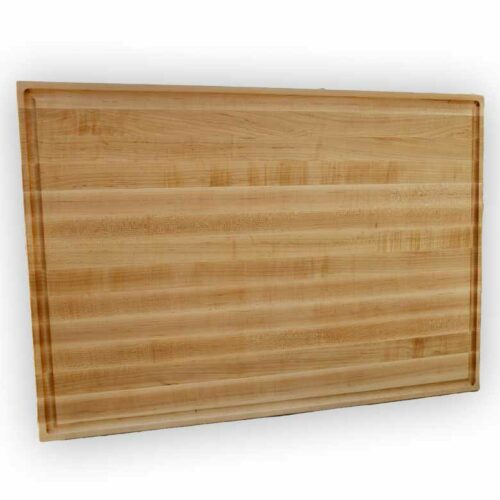

Edge Grain Cutting Boards

Up to 2″ Thick | Handcrafted in the USA | 30-Day Guarantee | Free Shipping

An edge grain cutting board is the workhorse choice for serious home cooks and professional kitchens alike. Built by orienting the long edge of each hardwood strip upward and gluing them together under controlled pressure, edge grain construction creates a dense, tightly bonded cutting surface that resists deep scarring, holds up to daily prep work, and stays flat for decades with proper care. Our edge grain cutting boards are milled up to 2 inches thick — nearly three times the standard retail thickness — and handcrafted to order from locally sourced cherry, maple, and walnut in our Nampa, Idaho workshop. If you need a specific size, shape, or custom engraving, we can build it. Contact us for a free custom quote.

Why Our Edge Grain Cutting Boards Are Built Differently

  • Locally and ethically sourced domestic hardwoods — cherry, maple, and walnut — hand-selected before any cut is made
  • Milled close to 2″ thick, significantly heavier and more stable than the ¾″ boards found in most stores
  • Edge grain construction creates a hard-wearing surface that resists deep scarring and won’t buckle under daily use
  • Assembled with waterproof glue and clamped under controlled pressure — joints that won’t delaminate over time
  • Every board arrives pre-conditioned with food-safe mineral oil, ready to use straight out of the box
  • Proudly handmade in the USA by real craftspeople — not mass-produced overseas
  • Precision laser engraving available for gifts, weddings, and personalized kitchen pieces
  • Backed by our 30-Day Craftsmanship Guarantee — we stand behind every board we build
  • Carefully wrapped and packaged for damage-free delivery via FedEx or UPS
  • Free ground shipping to all lower 48 states

Shop Edge Grain Carving Boards — Cherry, Maple & Walnut

Browse our full collection of handmade edge grain cutting boards below. Available in cherry, maple, and walnut in a wide range of sizes — from compact prep boards to large professional-grade surfaces. All boards are in stock and built to order. Use the shop navigation to filter by wood species.

Shop Edge Grain Cutting Boards by Wood Species

We offer edge grain boards in three domestic hardwoods. Each has a distinct character — choose based on your kitchen style, how hard you cook, and how much visual drama you want on your counter.

cherry edge grain cutting boards

American black cherry brings warm reddish-brown tones that deepen beautifully with age and use. On the Janka hardness scale, cherry registers around 950 — the softest of our three options, which makes it slightly more susceptible to visible knife marks over time, but also the easiest to sand and restore. Cherry edge grain boards are a popular choice for gifting and for cooks who want a board that gets more beautiful the more it’s used. Pair with optional laser engraving for a personalized kitchen piece that lasts a lifetime.

maple edge grain cutting boards

Hard maple is the benchmark cutting board wood — 1,450 on the Janka scale, neutral pale color, and the tightest grain of the three. Maple edge grain boards resist deep scoring better than any comparable domestic hardwood, clean easily, and stay flat through years of heavy daily use. If you want the most durable edge grain surface with the lowest maintenance burden, choose maple.

walnut edge grain cutting boards

American black walnut hits around 1,010 on the Janka scale — a step below maple but still an excellent cutting surface. Walnut’s deep chocolate-brown tones make it the most visually dramatic of the three, and its slightly softer surface is easier on knife edges than maple. Walnut edge grain boards are the choice for cooks who want both serious performance and a board that makes a statement on the counter.

Edge Grain vs. Face Grain vs. End Grain: Which Cutting Board Is Right for You?

Construction Type How It’s Built Best For
Edge Grain (These Boards) Long edges of hardwood strips glued upright, forming a tight linear surface Heavy daily use, durability, long-term value
Face Grain Wide flat face of the plank forms the cutting surface Display, occasional use, beautiful natural figure
End Grain (Butcher Block) Cross-section of wood fibers faces up — the classic butcher block Knife-friendly prep, professional kitchens, heirloom pieces

Edge Grain — The Practical Workhorse

Edge grain boards are where performance and price meet in the most balanced way. The long, parallel fiber structure creates a surface that’s harder-wearing than face grain and easier to maintain than end grain. Knives glide across the surface without catching on exposed fibers, and the dense construction resists the deep groove patterns that develop on cheaper boards over time. For a home cook who wants a board they can actually use hard every day without babying it, edge grain is often the right answer.

Face Grain — Beauty First

Face grain boards show off the wood’s natural figure most dramatically — sweeping grain patterns, full color variation, the character of a single plank. The tradeoff is a softer surface that shows knife marks more readily than edge grain. Face grain boards are ideal for light prep work, cheese and charcuterie presentation, or as a display piece that also pulls its weight occasionally. Browse our face grain cutting boards in cherry, maple, and walnut.

End Grain — The Premium Choice for Knife-Focused Cooks

End grain construction — where the cross-section of wood fibers faces up — is the most knife-friendly surface available. Your blade slides into the grain rather than across it, producing less edge wear over time. End grain boards also have a degree of self-healing: the fibers close around cuts rather than staying open. The tradeoff is weight, cost, and higher maintenance needs. End grain boards require more frequent oiling to prevent drying and cracking. Browse our end grain butcher blocks in cherry, maple, and walnut.

edge grain cutting boards

All About Our Edge Grain Cutting Boards

What Makes an Edge Grain Cutting Board Worth Owning

Not all cutting boards are built the same, and not all edge grain boards are built the same either. Understanding what separates a well-made edge grain board from a cheap one makes it easier to see why construction quality has a direct impact on how long your board lasts — and how it performs every day in between.

Watch Our Cutting Board Building Process

What ‘Edge Grain’ Actually Means — and Why It Matters

Picture a plank of lumber lying flat. The wide top face is the face grain. The narrow long side — the edge of the plank — is the edge grain. When we build an edge grain cutting board, we glue multiple strips of hardwood together with those long edges facing upward. That tight arrangement of vertical, parallel fibers is the surface your knife meets.

This orientation matters for two reasons. First, the long fibers run parallel to your knife blade as you cut, so your edge glides across the surface rather than dragging across exposed grain. This reduces friction during prep and reduces edge wear on your knives over time. Second, the construction creates a mechanically strong, impact-resistant surface that distributes stress across a large bonded area — which is why edge grain boards can withstand hard daily chopping without developing the cracks, warps, and deep grooves that cheaper boards show after a year or two.

Thickness Matters More Than Most Buyers Realize

The edge grain boards you’ll find at a big-box store are almost always 3/4 of an inch thick. Ours are built up to 2 inches thick. That’s not a minor difference — it changes the board fundamentally. A 2-inch edge grain board has real mass, which means it stays put on the counter. It has real depth, which means you can sand it back to a fresh surface multiple times over decades of use. And it has structural integrity that resists the warping from heat and moisture exposure that thinner boards can’t fight.

We maximize thickness on every build. When you pick up one of our edge grain cutting boards, you notice it immediately. It feels like a professional tool — because it is.

Easier on Your Knives Than You’d Expect

A board that dulls your knives costs you money and frustration every time you sharpen. Edge grain construction keeps blades sharper longer because your knife isn’t dragging across exposed wood end fibers — it’s making smooth, consistent contact with the long edge grain running in the same direction as your cuts. This is why edge grain boards are the preferred choice in professional kitchen settings where knife maintenance is a real operating cost.

A Surface That Looks as Good as It Performs

Edge grain boards have a distinctive visual identity — parallel lines of grain, natural color variation between strips, the warmth of cherry or the depth of walnut. These aren’t manufactured aesthetics. They’re the natural character of the wood, amplified by the way edge grain construction puts the grain front and center in clean, parallel lines. These boards look intentional on a counter because they are.

How We Build Our Edge Grain Carving Boards: Step by Step

Step 1. Your Order Triggers the Build

There’s no warehouse inventory. The moment your order is placed, your board goes into the build queue. Every piece is made specifically for you, not pulled from a shelf.

Step 2. Wood Selection

We source hardwood locally from trusted suppliers in Idaho and the Pacific Northwest. Before any cut is made, we hand-inspect every piece for grain consistency, density, and color. Material that doesn’t meet our standards doesn’t become a cutting board.

Step 3. Milling & Edge Grain Assembly

Each strip is planed to precise, uniform thickness. We orient the long edge of every strip upward — this is the edge grain orientation that defines this board type. Strips are arranged for visual balance and grain consistency, then glued with waterproof structural adhesive and clamped under controlled pressure until fully cured.

Step 4. Sanding & Detailing

Each board is progressively sanded through multiple grits to remove tool marks, smooth glue lines, and bring edges to a comfortable bevel. We don’t rush this step. The final surface should feel as refined as it looks.

Step 5. Custom Laser Engraving (if ordered)

Every engraving design is reviewed and confirmed before the laser touches the board. After engraving, a light re-sanding removes raised grain fibers while preserving crisp, clean detail. The result looks intentional — not machine-stamped.

Step 6. Sealing & Conditioning

Every board is conditioned multiple times with food-safe mineral oil before it ships. This isn’t a surface coat — it’s a thorough treatment that penetrates the wood grain and prepares the board for long-term use from day one.

Step 7. Hands-On Inspection

Before packaging, every board is hand-checked for flatness, finish quality, glue joint integrity, and overall appearance. If it doesn’t pass inspection, it doesn’t ship.

Step 8. Shipped Free to Your Door

Free ground shipping via UPS or FedEx to all lower 48 states. You’ll receive tracking as soon as your order ships. Standard build time is 12–15 business days.

How to Care for an Edge Grain Cutting Board

A properly cared-for edge grain cutting board can last 20 to 30 years or more. The good news is that edge grain boards are one of the lower-maintenance construction types — here’s exactly what they need.

Oiling — The Most Important Step

Apply food-safe mineral oil or board butter to all surfaces — top, bottom, and all four sides — when the board is new. Repeat every few days for the first two to three weeks until the wood stops readily absorbing oil. After that initial seasoning period, a monthly application is sufficient for most boards. When your edge grain board starts to look dry or lighter in color than usual, it’s time to oil. Never use vegetable, olive, or coconut oils — they go rancid inside the wood.

Cleaning

Hand wash only, every time. Use warm water and a small amount of dish soap — the common myth that soap damages wood cutting boards is inaccurate. What actually damages wood boards is prolonged soaking and the dishwasher. After washing, dry immediately with a clean towel and stand the board upright or on a rack so both sides can air dry evenly.

Never Use the Dishwasher

The combination of sustained high heat, prolonged steam exposure, and harsh detergents will cause your edge grain board to crack, warp, and delaminate. This applies universally to all quality wood cutting boards, regardless of construction type.

Sanitizing

For deep cleaning or odor removal, sprinkle coarse kosher salt over the surface and rub with half a lemon. The salt acts as a mild abrasive and the lemon’s acidity neutralizes odors and lifts surface staining. Rinse lightly and dry immediately.

Removing Marks and Knife Scars

Lightly sand the surface with 220-grit sandpaper to remove shallow knife marks, surface stains, and small scratches. After sanding, wipe away all dust and re-oil the entire board immediately. This restoration process can be repeated many times over the life of the board — one of the core advantages of real wood over plastic or bamboo alternatives.

Storage

Store your edge grain cutting board flat or standing upright with airflow on both sides. Avoid leaning it against a wall for extended periods, especially in areas with humidity differentials, as uneven moisture exposure can promote warping over time.

Built to Last — Not Built to Be Replaced

Edge grain boards hold up to serious kitchen work because the wood is doing what it’s engineered to do. The long, parallel grain structure distributes impact across the surface rather than concentrating stress in one area. Combined with our 2-inch thickness — nearly three times what you’ll find in most retail boards — the result is a board with real mass and real stability. It stays flat. It doesn’t slide around. It feels like a tool, not a prop.

With proper care — regular oiling and hand washing — an edge grain board from our shop should last decades. That’s not a marketing claim; it’s the nature of quality hardwood construction.

Easier on Your Knives Than You’d Expect

A board that damages your knives isn’t doing its job. Edge grain construction keeps your blades sharper longer because the grain runs in the same direction as your cuts. You’re not dragging the edge across exposed wood fibers — you’re making contact with a smooth, consistent surface. Serious home cooks and professional chefs choose edge grain boards specifically because they want a surface that complements the work rather than fighting it.

Condition Your Board

Our board butter is formulated from 100% food-safe ingredients to nourish, protect, and extend the life of your cutting board. Apply it monthly to keep the wood hydrated, prevent cracking, and maintain the finish. A well-oiled board is a board that lasts.

A Surface That Looks as Good as It Performs

Edge grain boards have a visual identity all their own. The parallel lines of the grain, the variation in tone between strips, the warmth of cherry or the depth of walnut — these aren’t manufactured aesthetics. They’re the natural character of the wood you selected, amplified by the way edge grain construction puts that grain front and center. These boards work every day and look good doing it.

Learn What Customers Think of Our Edge Grain Cutting Boards

Edge Grain Cutting Boards as Gifts

A handmade edge grain cutting board is one of the most practical and lasting gifts you can give — and one of the few kitchen gifts that earns a permanent spot on the counter and gets used every single day. Unlike gadgets that end up forgotten in a drawer, a quality cutting board gets better with age and use.

Our edge grain boards are a popular choice for wedding gifts, housewarming presents, milestone birthdays, chef gifts, and holiday giving. With our optional precision laser engraving, they become something truly personal — a name, a wedding date, a family crest, a meaningful quote, or a custom monogram transforms a beautiful board into an heirloom people keep for decades and talk about when guests notice it on the counter.

We build custom sizes for gifting as well. If you have a specific dimension in mind, or want a board paired with a jar of our board butter, contact us for a custom quote. Every board ships carefully packaged and arrives gift-ready. Learn more about our engraving options.

walnut cutting board

Frequently Asked Questions

An edge grain cutting board is built by gluing multiple strips of hardwood together with the long edge of each strip facing upward. This creates a tight, dense cutting surface where wood fibers run parallel to your knife blade. The result is a board that resists deep gouging, distributes impact across a large bonded surface, and holds up to daily kitchen use far better than thinner or more cheaply constructed alternatives.

Edge grain boards have long parallel wood fibers running across the surface — the side of each strip faces up. End grain boards (butcher blocks) have the cross-section of the wood fibers facing up, so your knife slides into the grain rather than across it. End grain boards are gentler on knife edges and have a degree of self-healing, but they cost more, weigh more, and require more frequent oiling. Edge grain boards are more affordable, easier to maintain, and highly durable — the better everyday choice for most cooks. Both are excellent products; the right one depends on your priorities.

Edge grain is more durable than face grain for daily use. Face grain boards show the full natural figure of the wood most dramatically, but the surface is softer and shows knife marks more readily. Edge grain construction creates a harder-wearing surface that stays cleaner and smoother through years of heavy prep work. For a board you’ll use hard every day, edge grain is the better practical choice. For a display piece or occasional-use board, face grain is beautiful and perfectly functional.

We source all of our hardwood locally from trusted suppliers in Idaho and the surrounding Pacific Northwest region. Every piece is hand-selected in person for grain consistency, density, and color before it enters our shop. If it doesn’t meet our standards, it doesn’t become a cutting board.

Our standard turnaround is 12–15 business days outside of peak seasons. Because every board is built to order from scratch — not pulled from existing inventory — there’s real craft happening between your purchase and your delivery. Most customers tell us the wait is well worth it the moment they see the board.

Yes. Every board ships fully conditioned with food-safe mineral oil — applied multiple times during the finishing process, not just a surface coat. Your board is protected from the inside out and ready to use the moment it arrives. We recommend applying Board Butter monthly thereafter to maintain the finish.

We ship via UPS and FedEx ground service to all lower 48 states at no charge. The carrier is selected based on your location and the size of your order to get it there as quickly and safely as possible. All boards are carefully wrapped and packaged to prevent damage in transit. Oversized and heavier boards may ship via UPS or FedEx Freight.

The boards you find at big-box retailers are almost always mass-produced overseas, typically ¾” thick, and made from lower-grade materials. Ours are handmade in the USA from hand-selected domestic hardwood, milled up to 2 inches thick, and built by craftspeople who care about the outcome. You’ll notice the difference the first time you set one on your counter.

Yes. Every edge grain cutting board comes with our 30-Day Satisfaction Guarantee. If you’re not completely satisfied, we’ll make it right. Read the full guarantee on our website.

Absolutely. Our listed sizes are our most popular configurations, but we build custom dimensions regularly — larger prep surfaces, specific sizes to fit existing counter cutouts, unusually proportioned boards for outdoor kitchen setups, and more. If you have a specific size or shape in mind, request a free custom quote and we’ll work out the details with you.

The most important differences are thickness, craftsmanship, and origin. Store boards are almost universally 3/4 of an inch thick, mass-produced overseas, and built to a price point. Ours are milled up to 2 inches thick, handmade in Nampa, Idaho, by craftspeople who hand-select lumber and inspect every board before it ships. You’re not getting a product designed to look good in photos. You’re getting a board designed to perform for decades.


View this profile on Instagram


Custom Furniture (@mahoganyhousewoodworks) • Instagram photos and videos

Get A Custom Quote

Do you need a cutting board custom built to a specific size and specs?


Latest Blog Posts

Father’s Day Cutting Board Gifts

\Why a Custom Wood Cutting Board is the Perfect Father’s Day Present Father’s Day is right around the corner, and you’re probably staring down the usual suspects: a tie he won’t wear, a grill tool set he already has three of, or a gift card that says “I ran out of ideas.” This year, skip…

How Strong Is a 4-Inch Thick Solid Wood Cutting Board?

When most people think of a cutting board, they picture a thin board from a department store — lightweight, easy to flex, and usually worn out within a couple of years. But a true thick hardwood butcher block is in an entirely different category. A 4-inch thick solid wood cutting board is less like a…

Using Magic Eraser on Wood Cutting Boards

Is It Safe to Use a Magic Eraser on a Wood Cutting Board? If you’ve ever looked down at your wood cutting board and noticed dark stains, knife marks, or lingering odors, you’re not alone. Cutting boards take a beating—especially when they’re used daily. Naturally, many homeowners start looking for a quick fix, and one…